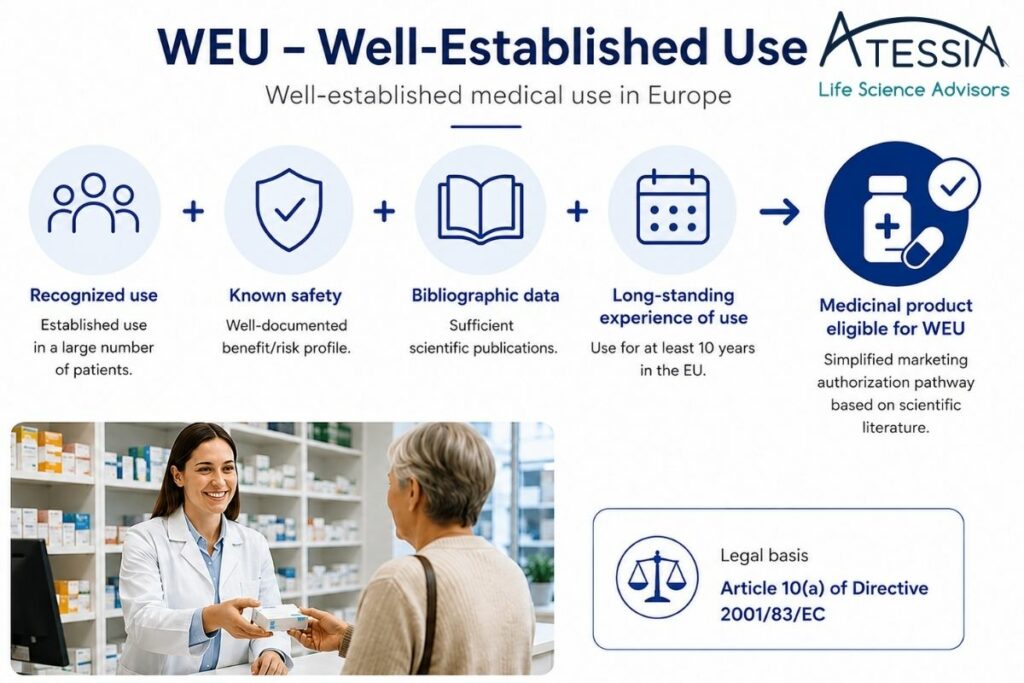
The legal basis of “well-established use/ WEU” (well-established use) in Article 10(a) of Directive 2001/83/EC constitutes a specific regulatory pathway for obtaining a marketing authorization (MA) for a medicinal product within the European Union (EU) without having to submit a complete dossier of original preclinical and clinical trials. This is referred to as a literature-based application. This approach relies on the use of existing scientific data demonstrating the efficacy and safety of an active substance with a long-standing and recognized use.
• Recognized medical use for at least 10 years in the EU,
• Efficacy and safety profile demonstrated to be acceptable based on usage,
•Scientific consensus widely documented in the literature.
These criteria imply that the assessment is based on a robust body of scientific evidence, including in particular:
• Publications in peer-reviewed journals,
• Meta-analyses,
•Clinical guidelines,
•Post-marketing experience data.
However, the existence of extensive literature alone is not sufficient to claim well-established medical use. The quality of the data, its relevance, and its suitability for the product under development remain key factors in the evaluation.
A scientific demonstration that goes beyond a simple literature review
One of the most common pitfalls is to view a WEU dossier primarily as a bibliographic exercise. In fact, the authorities generally expect more than just a compilation of publications. MA holders must be able to explain how the data described in the literature can be applied to their product. It is therefore not merely a matter of knowing whether data exist, but of determining to what extent this data supports the product in question and how this demonstration can be robustly documented.
Recent European clarifications have brought the topic of “bridging” back into the spotlight.
“Bridging” refers to a comparative analysis between the drug being submitted for approval and the product(s) cited in the scientific literature, in order to demonstrate that the data from the literature cited to support efficacy and safety are relevant to the specific drug being submitted for approval.
In 2025, the EMA published a Q&A document (“Clinical Pharmacology and Pharmacokinetics: Questions and Answers”) aimed at harmonizing the assessment of “bridging” requirements in applications based on Well-Established Use.
The guiding principle of this document is to demonstrate that the published data pertain to a product sufficiently comparable to the one for which the marketing authorization application is being filed. Depending on the situation, this demonstration may involve pharmaceutical, pharmacokinetic, or clinical analyses to establish the link between the data in the literature and the drug candidate for WEU.
The guidelines do not always provide a direct answer applicable to all scenarios. Rather, they emphasize the importance of a scientific justification tailored to each product and each registration strategy.
•Analysis of the relevance of the legal basis under Article 10(a) in light of available bibliographic data;
•Identification of any bridging requirements;
•Structuring the regulatory strategy for the application: assisting you in a thorough review of the application’s overall consistency and the evidence supporting the choices made.
The goal is not to apply a one-size-fits-all approach, but to help applicants clarify the available options and ensure the overall logic of the development.
The electronic Common Technical Document (eCTD) is a standardised format for submitting regulatory information to health authorities. Originally implemented using index files based on Extensible Markup Language (XML) and PDF documents, the eCTD streamlines the electronic submission of dossiers, ensuring consistency and efficiency in regulatory processes.
In Europe, the eCTD format is mandatory since 2019 for all regulatory submissions, whether initial marketing authorisation (MA) applications or variations for centralised, decentralised and national procedures.
Changes introduced by eCTD v4.0
The introduction of eCTD v4.0 (the latest version of the eCTD format) marks a significant step towards a more harmonised and efficient electronic submission environment, offering optimised metadata structures, improved lifecycle management and enhanced interoperability with global regulatory authorities.
Developed by the ICH, the eCTD facilitates the structured submission of data required for the MA of new medicines and the management of regulatory information throughout the medicine’s lifecycle. This latest version will replace the previous version (eCTD 3.2.2) and offer improved features and capabilities.
The four main benefits offered by eCTD v4.0, as reported by publishers of regulatory submission software, are as follows:
#1
Enhanced lifecycle management features
eCTD v4.0 promotes a more comprehensive approach to lifecycle management, as it allows for greater flexibility in managing content changes.
#2
Easy correction of metadata
In eCTD v4.0, keywords play a key role in organising similar information, such as details on products, substances and manufacturers. They make it easy to correct typos, which simplifies the updating process and ensures the accuracy of eCTD submissions whenever changes to the metadata are required.
#3
Greater flexibility
eCTD v4.0 allows for more flexible updates to the structure of submissions. These updates are managed viacontrolled vocabularies.
#4
The reuse of documents
eCTD v4.0 allows a document to be submitted to a regulatory authority just once, referring to its unique identifier (UUID) with subsequent submissions (within the same application or across different applications). This streamlines both the creation and revision of submissions.
To be noted: working documents relating to eCTD sections are not subject to the rules of eCTD v4.0 and must always be submitted “outside” the eCTD folder.
The implications of eCTD v4.0 for industry and health authorities
For industry and health authorities, the benefits of eCTD v4.0 are as follows:
> It provides internationally harmonised rules for creating and managing electronic submissions, without requiring specific software development for the EU.
> It simplifies dossier lifecycle activities, including the addition of new requirements or the adjustment of content granularity.
> It allows documents already submitted in other procedures (worksharing, PSUR, DCP/MRP) to be reused.
> It allows content already submitted to continue to be used via a single transition message.
> It facilitates better support for the automation of administrative processing.
> It reduces the maintenance of tools for managing and reviewing submissions, and facilitates future support for other types of regulated products (medical devices, clinical trials, veterinary products).
> It can indicate whether content has already been assessed by an agency and the outcome of that assessment, which can avoid additional reviews.
Furthermore, it will be possible to transfer the current content from version v3.2.2 to version v4.0 and continue the eCTD lifecycle in version v4.0.
In summary, significant time savings are expected with the implementation of eCTD v4.0 for all stakeholders.
The entry into force of eCTD 4.0 in Europe
Following the launch of pilot phases starting in 2024, followed by the optional use of eCTD v4.0 for medicinal products authorised under the centralised procedure (CP) only from December 2025, a phased implementation of eCTD v4.0 is planned in Europe as follows:
> 2026: optional use of eCTD v4.0 for medicines authorised under the decentralised procedure (DCP)/mutual recognition procedure (MRP)/national procedure (NP).
> 2027: mandatory use of eCTD v4.0 for medicines authorised under the centralised procedure (CP).
> To be determined: mandatory use of eCTD v4.0 for medicines authorised under the decentralised procedure (DCP)/mutual recognition procedure (MRP)/national procedure (NP).
To prepare for the future, minimise disruption to the management of their product lifecycle and maximise their competitive advantages, the regulatory affairs departments of pharmaceutical companies are strongly encouraged to undergo training on eCTD 4.0 as soon as possible.
ATESSIA’s consultants support pharmaceutical companies with developments relating to the formatting of electronic dossiers.
Labelling of medicinal products in France is an important tool to ensure safe use by patients by providing easy to understand key user information. It is also a tool to fight against counterfeiting of medicines.
Development of labelling for medicines in France is precise task that must take into account multiple regulatory requirements.
1. Regulatory Framework
In addition to the information foreseen by annex IIIA of the Marketing authorisation, many other requirements arise from the French regulation.
-Identification
Packaging of all medicines must include the national administrative number called code CIP (code identifiant de presentation = presentation identifier code) on both outer carton and inner packaging after the terms “Médicament autorisé n° …. » (13° of article R5121-138).
In addition, in line with the Directive 2001/83/CE and Delegated Regulation (EU) 2016/161, medicines must include an unique identifier(Articles R5121-138-1 and R5121-138-2) with exception to OTC products or POM products included in Annexe I of Delegated Regulation (EU) 2016/161 which are not requested to include the Unique identifier. In addition, packaging should bear an anti-tampering device on their packaging except for POM products included in Annexe I of Delegated Regulation (EU) 2016/161 .
In France, the Product Code (PC) (14-digit code) includes the national number (NN). The NN in France is the CIP and the PC corresponds to “0+code CIP” which should appear near the datamatrix and separately from the above mentioned “Médicament autorisé n° …. ».
-Legal Status
The legal status must be made available on both outer and inner packaging (17° of article R5121-138).
All medicines available on prescription are listed on List I or List II which determine how they can be delivered.
This classification must appear on the packaging with details as follow (Article R5132-15):
an empty frame with a red or a green border depending on the List;
In the coloured border, the text “respecter les doses prescrites*” in black font must be included;
the below information must then be mentioned :
“Liste I” or “Liste II”,
“Uniquement sur ordonnance”**,
“Ne pas avaler” (in case the product is not for oral, sublingual, perlingual or injectable administration)
In addition, if applicable, other information must appear in case:
the medicine is classified as narcotic or psychotic,
the medicine is subject to restricted or special prescription.
When medicines are contained in outer packaging that complies with the aforementioned provisions:
*The statement “Follow the prescribed doses” is not mandatory for ampoules or other small primary packaging where affixing this statement would not ensure optimal legibility of the information.
**The statement “Prescription only” is not mandatory for primary packaging containing only a single dose.
This information is made available in the prescription and delivery information approved by ANSM:
within the MA for product authorised via NP, MRP or DCP,
or within the blue box for product authorised via the CP.
-Pregnancy Pictogram
Requirement to include the Pregnancy pictogram has been introduced in 2017 and is included in Article R5121-139 of the French Public Health code. This pictogram placed on the outer packaging aims at providing patients with information on the risk of using the medicines during pregnancy or in case of childbearing potential. It concerns medicines with teratogenic or foetotoxic effects mentioned in the SmPC (sections 4.6 and 5.3).
Three situations are possible and the population in scope of the warning must be precisely mentioned below or on the right side of the pictogram:
DANGER
PROHIBITED
VALPROATE
The triangle must be equilateral and with a side of at least 1 cm. The circle must have a diameter of at least 1 cm. The colour of the form is red with white inner. The pregnant woman must be black.
Population in scope to be determined : « – l’adolescente ou la femme en âge de procréer, et sans contraception efficace ; – la femme enceinte ; – la femme enceinte à compter du [X]e mois de grossesse (lorsque la contre-indication porte sur une période précise de la grossesse). »
Population determined by law.
It is the responsibility of the MAH to determine the level of the pregnancy pictogram and the concerned population. It is highly recommended to ensure traceability of this pictogram determination and to ensure adequate stakeholders are involved.
These information will be then submitted to the French Agency upon declaration of marketing of the medicine.
-Pictogram regarding the effect on the ability to drive or use machines
Medicines which may reduce the ability to drive or operate machines must have a pictogram (warning triangle) (Article R5121-139). Its size is adapted to fit the label.
Since the ministerial order in 2008, 3 categories of pictograms have been identified for specific active substances (listed in ministerial decrees dated August 2008 and March 2017) in relation with the effect on the ability to drive. In addition, in case the active substance is not listed in the ministerial decree but is known to have such effect (based on section 4.7 of the SmPC), the MAH must include the neutral pictogram.
Active substance listed in Ministerial Decree
Active substance not listed in Ministerial Decree but known to have effects on the ability to drive and use machines
Level 1
Level 2
Level 3
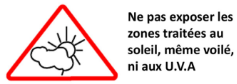
-Pictogram for medicinal products containing ketoprofen as topical gel to avoid sun exposure of treated skin areas
-Other pictograms
Article R5121-139 also states that the outer packaging may include, in addition to the company’s distinctive mark, signs or pictograms explaining some of the labelling information as well as other information consistent with the SmPC if they are useful to patients and not promotional in nature.
-Logos foreseen in the environmental code
In addition to the pictograms foreseen in the French pharmaceutical legislation, it is necessary to consider the inclusion of the pictogram “INFOTRI” aiming at explain how to eliminate different elements of the medicinal product.
This INFOTRI logo is mandatory on all products intended for household use.
This logo is to be included on one of the packaging elements of medicinal products used by patients (outer packaging or PIL (except of centralised procedure)). This is not requested for medicinal products used by Healthcare Professionals.
2. Other texts to consider:
In addition to the regulatory texts, various recommendations from the French HAs and from the EU regulators must be taken into account to develop, review and approve artworks :
Validation of artwork for France is under the responsibility of the Chief Pharmaceutical Officer (CPO) of the Exploitant. The validation can be supported by the below proposed table.
Registration procedure
What references to use
National
Annex IIIB; French labelling recommandations List provided in Prescription and delivery part of the MA
Article R5121-139 for effect on the ability to drive or use machines + ministerial decree + content of section 4.7 of the SmPC Internal assessment for the determination of the pregnancy pictogram level + sections 4.6 and 5.3 of the SmPC; CIP code provided by ANSM Article of article R5121-138 (point 17°) Article R5132-15 INFOTRI
MR and DC procedures
Annex IIIB; French labelling recommandations Mock-up approved during the MR or DC procedure List provided in Prescription and delivery part of the MA
Centralised
Annex IIIB; Blue box approved by the ANSM; Mock-up approved by the EMA QRD group
Atessia can support you for the development and review of artworks of medicinal products for the French Market.
What are the different options for registering an active substance in a Marketing Authorisation (MA) dossier in Europe?
The description of the data relating to the active substance is part of the information that are mandatory in Module 3 of the Marketing Authorisation (MA) dossier. These elements must be presented according to the general structure described in Directive 2001/83/EC of the European Parliament and of the Council of 6 November 2001 establishing a Community code relating to medicinal products for human use.
However, although the substance of the required data is specified in the European regulation, the way in which these data are incorporated in the MA dossier may vary depending on the option selected by the applicant when approving its active substance manufacturer.
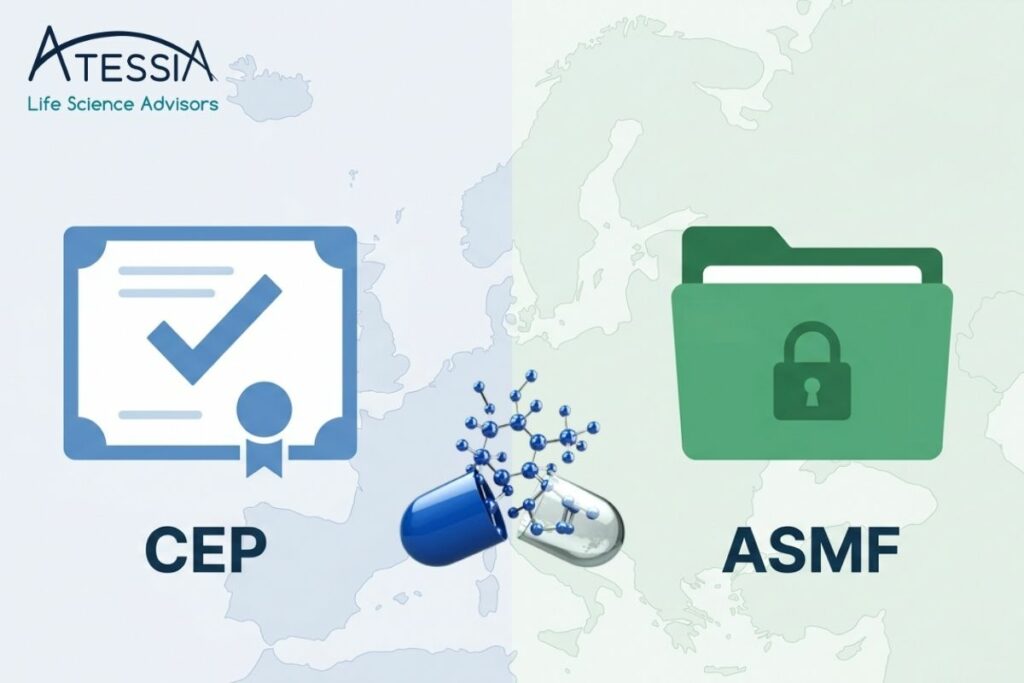
In Europe, the registration of a substance submitted by the MA holder may be carried out via an ASMF[1] (see Directive 2001/83/EC, Annex 1, Part 1, Chapter 3.2, Article (8)) or via a CEP (see Directive 2001/83/EC, Annex 1, Part 1, Chapter 3.2, Article (7)), with the choice of procedure being left to the active substance manufacturer (neither option being mandatory).
Another possibility is for the applicant to include, directly within the MA dossier, the data relating to the active substance in the form of a so‑called “full” scientific documentation package.
Different scenarios are distinguished depending on the type of active substance:
Type of active substance:
Applicable documentation route:
New chemical entity (NtA, Volume 2A, Chapter 1, Annex I)
ASMF or full documentation
Substance included in the European Pharmacopoeia
ASMF or CEP or full documentation
Substance not included in the European Pharmacopoeia
ASMF or full documentation
In this article, we focus on explaining the main differences between the CEP and the ASMF for registering an active substance in a marketing authorisation in Europe.
Focus on the CEP procedure
For further information on the CEP, see our blog article ‘What are CEPs?’.
Focus on the ASMF procedure
The requirements for the preparation of an ASMF in Europe are described in the EMA guideline entitled “Final Guideline on Active Substance Master File Procedure (CHMP/QWP/227/02, EMEA/CVMP/134/02)” and in the associated questions‑and‑answers document “Q&A on Active Substance Master File (ASMF)” jointly issued by the EMA and the CMDh.
The primary objective of the ASMF procedure is to ensure the protection of the intellectual property or confidential and valuable “know‑how” of the active substance manufacturer, while enabling the applicant or MA holder to assume full responsibility for the medicinal product, including the quality and quality control of the active substance.
The national competent authorities / the EMA have consequently access to all information necessary to assess the suitability of the active substance for use in the medicinal product.
Summary of the differences between the use of a CEP and an ASMF
A brief comparison of the advantages and disadvantages of the CEP and ASMF procedures for documenting the active substance section of a Marketing Authorisation Application (MAA) dossier is presented below.
Criterion
CEP
ASMF
Confidentiality of the active substance manufacturer’s data
Very high The entire Module 3.2.S is confidential (shared only with EDQM, not with the MA holder)
High Module 3.2.S is divided into two parts: > Restricted Part confidential > Applicant’s Part non‑confidential
Assessment
Module 3.2.S assessed by EDQM (mutualised assessment). → Questions addressed only to the active substance manufacturer
Applicant’s and restricted parts assessed by the authority where the ASMF is submitted (non‑mutualised assessment – with the exception of ASMF worksharing procedure) → Questions on restricted part sent to the manufacturer; questions on applicant’s part sent to the MA holder
Workload for the MA holder
Low
Medium
Workload for the active substance manufacturer
High initially, then low
Medium
Management of MA variations related to the active substance
Very efficient: variations handled through CEP updates
Medium
When recommended?
Substance with a Ph. Eur. monograph / widely marketed active substance
Substance with or without a Ph. Eur. monograph / need to protect proprietary know‑how
Regulatory procedures, evaluation times and associated costs vary.
ATESSIA consultants assist you in preparing your CEP and ASMF/DPSA files and submitting them to the authorities.
– EUR-Lex – Directive 2001/83/CE du Parlement européen et du Conseil du 6 novembre 2001 instituant un code communautaire relatif aux médicaments à usage humain
– EudraLex – Volume 2 – Notice to Applicants, Volume 2A, Chapter 1, Annex I