

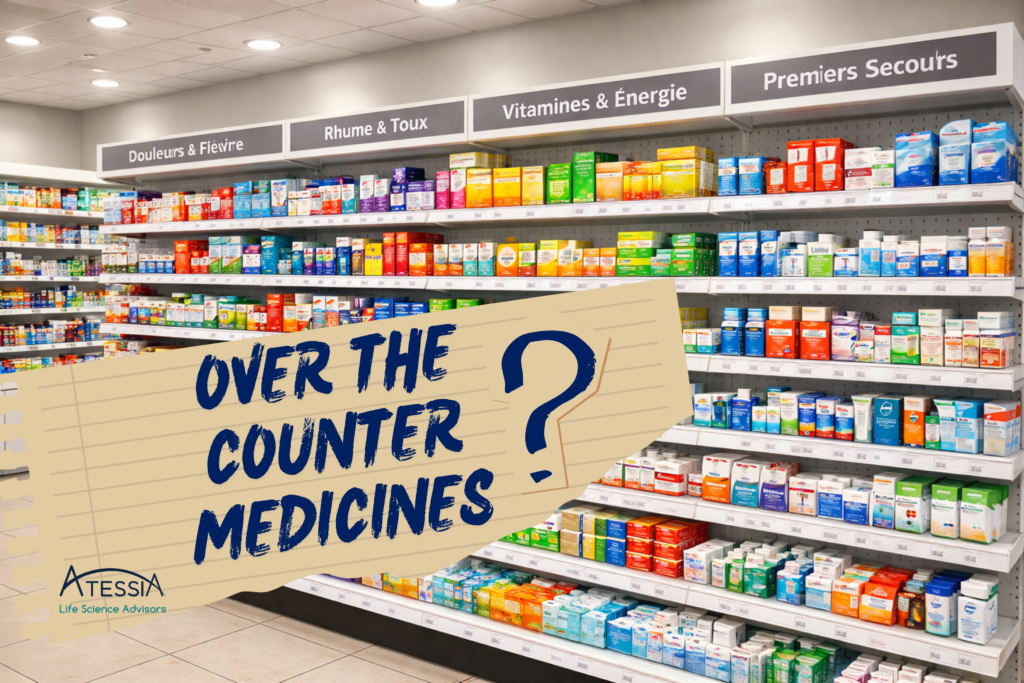
Do “over the counter” medicines exist in France?
| French always do it different In many domains, French people like to stand out, either in a positive or negative way.In the Healthcare field, France has set a system that is highly effective, and very protective for the patient, but at the price of a heavy state involvement and of one of the most complex regulations. As a result, understanding the regulatory specificities of France is key for entering the French market. ATESSIA can help you in this process and provide you assistance and expertise. Here are a few areas where France follows its own, often complicated and restrictive, rules. |
What are direct-access medicines ?
Over-the-counter (OTC) drugs do not constitute a legal category of drugs under French or European law. This concept, imported from Anglo-Saxon countries, refers to drugs that are directly available to patients at authorized dispensing locations. They promote responsible self-medication and patient autonomy.
In France, since July 1, 2008, certain medicines known as officinal medicines (MMO) can be made directly available to the public in pharmacies, under strict conditions. They are referred to in several ways: “self-medication medicines“, “over-the-counter medicines” or “direct access medicines“
A dedicated space in pharmacies
Article R. 4235-55 of the Public Health Code (CSP), authorizes pharmacists to display MMO in a dedicated, clearly identified space located in the immediate vicinity of the dispensing and pharmaceutical record stations.
Their dispensing remains subject to the effective control of the pharmacist, in accordance with the obligation to provide advice imposed on them by the Code of Ethics and Good dispensing practices.
Eligibility Criteria for Inclusion on the MMO List
To be presented for direct public access, medicines must be listed by the Director General of the National Agency for the Safety of Medicines and Health Products (ANSM). Under Article R.5121-202 of the PHC, inclusion is subject to the following conditions:
- Medicine must not require a mandatory medical prescription (excluding those classified in Lists I and II of poisonous substances, such as narcotics, as well as other medicines subject to restricted prescription);
- Therapeutic indications, treatment duration, and information provided in the package leaflet must allow safe use by the patient, on pharmacist advice and without a medical prescription: : symptoms must be easily recognisable and must not risk concealing a serious condition;
- Packaging (weight, volume, number of dosage units) must correspond to the posology and recommended treatment duration indicated in the leaflet;
- The medicine must not be subject to advertising restrictions for public health reasons;
- It must not appear on the lists provided for under Article L.162-17 of the Social Security Code, which qualifies for reimbursement by health insurance.
The required documentation for the application is detailed in the ANSM document, “Modalities for Submitting Requests to Add, Modify, or Remove a Medicine from the List of Officinal Medications for Direct Public Access”, available on the ANSM website.
Following review, under Article R.5121-203, the ANSM’s Director General may, by reasoned decision, refuse the listing of medicine on public health grounds, including after reassessment of the benefit-risk balance. The Director General may also suspend or remove a medicine from the list if it no longer meets the criteria of Article R.5121-202 or for any public health reason.
Advertising authorized for the public
Given the criteria imposed by Article R.5121-202, these drugs meet the conditions imposed by Article L.5122-6 of the CSP and may therefore be advertised to the public, subject to obtaining a GP (“Grand Public”) visa.
The ANSM recommendations specify that reference to the fact that it is an officinal medicine remains possible provided that “it is sober and informative in nature […]”. This reference cannot constitute the main focus of the communication and must not be interpreted in its form as “[…] an official accreditation or label for the advertising message.”
Messages or slogans must not suggest that the medicine is effective or safe.
Conclusion: Balancing Accessibility and Safety
The French regulatory framework allows community pharmacists to provide direct public access to certain non-prescription medicines, provided that their MA permits safe use under pharmacist guidance. This voluntary procedure for MA holders balances healthcare accessibility and patient safety while complying with strict regulatory requirements.
Article written by Arthur DI RUGGIERO, Regulatory Affairs Advisor