Marketing Authorization (MA)

Centralised Procedure

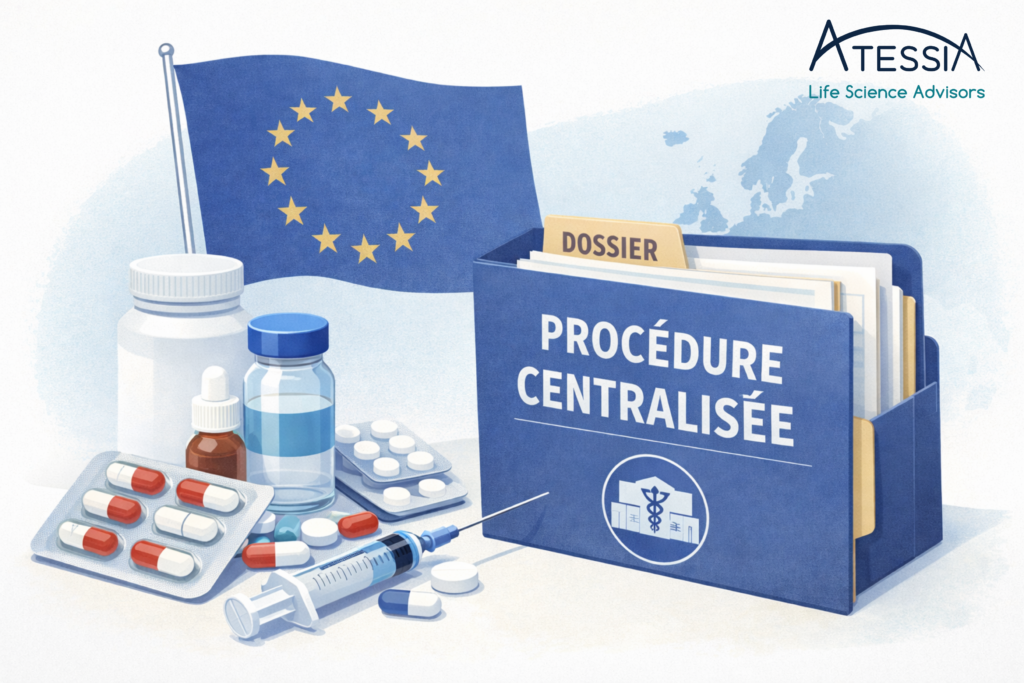
The centralised procedure is defined by Regulation (EC) No 726/2004 of the European Parliament and of the Council of 31 March 2004 laying down Community procedures for the authorisation and supervision of medicinal products for human and veterinary use and establishing the European Medicines Agency (EMA).

This procedure allows obtaining a single marketing authorisation (MA), issued by the European Commission, valid in all Member States of the European Union as well as in the Member States of the European Economic Area (EEA): Iceland, Liechtenstein and Norway.

1/ Scope of application

The centralized procedure is mandatory for certain categories of medicines :

  • advanced therapy medicinal products
  • biotechnology medicinal products
  • medicinal products containing a new, unauthorized active substance used in the treatment of acquired immunodeficiency syndrome (AIDS), cancer, neurodegenerative diseases, diabetes autoimmune diseases and other immune dysfunctions, and viral diseases
    • orphan drugs.

It is optional for other categories of medicines which, although not mandatory, may be of interest at the European level. These include:

  • medicines containing a new active substance that, as of 20 May 2004, was not authorized in the European Union
  • medicines representing a significant therapeutic, scientific, or technical innovation
    • medicinal products presenting an interest for patients at European Union level.

Generic medicines of a reference medicine authorised in the European Union may also be eligible for the centralised procedure.

2/ The actors involved

The Committee for Medicinal Products for Human Use (CHMP), the EMA’s scientific body, is at the core of the centralized procedure. To carry out its pharmacovigilance tasks, the CHMP relies on the scientific assessment and recommendations of the Pharmacovigilance Risk Assessment Committee (PRAC).

The main actors are :

  • The applicant : the holder of the marketing authorisation application.
  • The rapporteurs and co-rapporteurs : two Member States appointed by the CHMP to assess the application and draft the assessment reports.
  • The CHMP : responsible for the scientific review and for providing  an opinion on the benefit/risk balance of the medicinal product.
  • The European Commission : the competent authority for the final marketing authorisation decision, based on the CHMP’s opinion.

3/ Timetable

The total duration of the scientific evaluation is 210 days, excluding clock stops to allow the applicant to answer questions from the CHMP.

Pre-submission

The applicant may arrange a pre-submission meeting with the EMA. These meetings are an essential opportunity to obtain procedural and regulatory advice from the Agency and to ensure that the application complies with the requirements of the centralised procedure.

Submission and validation

The complete dossier is submitted via the EMA portal. A technical validation is carried out, covering the dossier structure (eCTD), as well as a validation of the administrative and regulatory content. Once these validations are completed, the scientific evaluation officially begins on Day 1.

First evaluation (Day 1 to Day 120)

The rapporteurs and co-rapporteurs appointed by the CHMP carry out their initial scientific evaluation and draft a preliminary assessment report, consolidated with comments of the other members of the CHMP.

A peer review is then conducted by the rapporteur and co-rapporteur to harmonize opinions and finalize the list of questions to be addressed to the applicant. Day 120 marks the start of the clock-stop period, during which the applicant typically has up to three months to prepare its response document. Response time is not included in the 210 regulatory days.

Second evaluation (Day 121 to Day 210)

After the clock-stop period, the CHMP resumes the scientific evaluation based on the responses provided by the applicant (Day 121). This phase aims to verify that all questions have been adequately addressed and to finalize the Final Assessment Report (joint assessment) (Day 150).

If some questions remain unresolved or if a point requires clarification, the CHMP may hold a second clock-stop, during which the applicant provides additional information (Day 180).

After this second clock-stop, an oral explanation may be requested by either the applicant or the CHMP (Day 181). This hearing is generally held when the CHMP maintains major objections and allows the applicant to respond directly to the critical points raised by the committee.

Once all the answers to the questions have been received, the Final Assessment Report can be finalized and the CHMP adopts its final opinion on the benefit-risk balance of the medicinal product (Day 210). This opinion may be positive, adopted either by consensus or by an absolute majority of members, or negative. In the event of a negative opinion, the applicant has the right to appeal the decision in accordance with EMA’s procedures.

European Commission Decision

When the CHMP opinion is positive, the European Commission has 67 days to make the final decision on granting the marketing authorisation.

4/ In summary

The centralized procedure is the preferred authorisation route for innovative medicines seeking a European presence. It ensures a harmonized scientific evaluationassessment. However, its complexity requires solid strategic preparation and proven regulatory expertise.

ATESSIA supports pharmaceutical companies in defining their registration strategy, preparing and submitting applications under the centralised procedure, and managing interactions with both the EMA and the European Commission.

Article written byLamya SAOUSSEN, Junior Regulatory Affairs and External Communication Advisor 

What are the next steps for therapeutic cannabis in France? 


A bit of history 

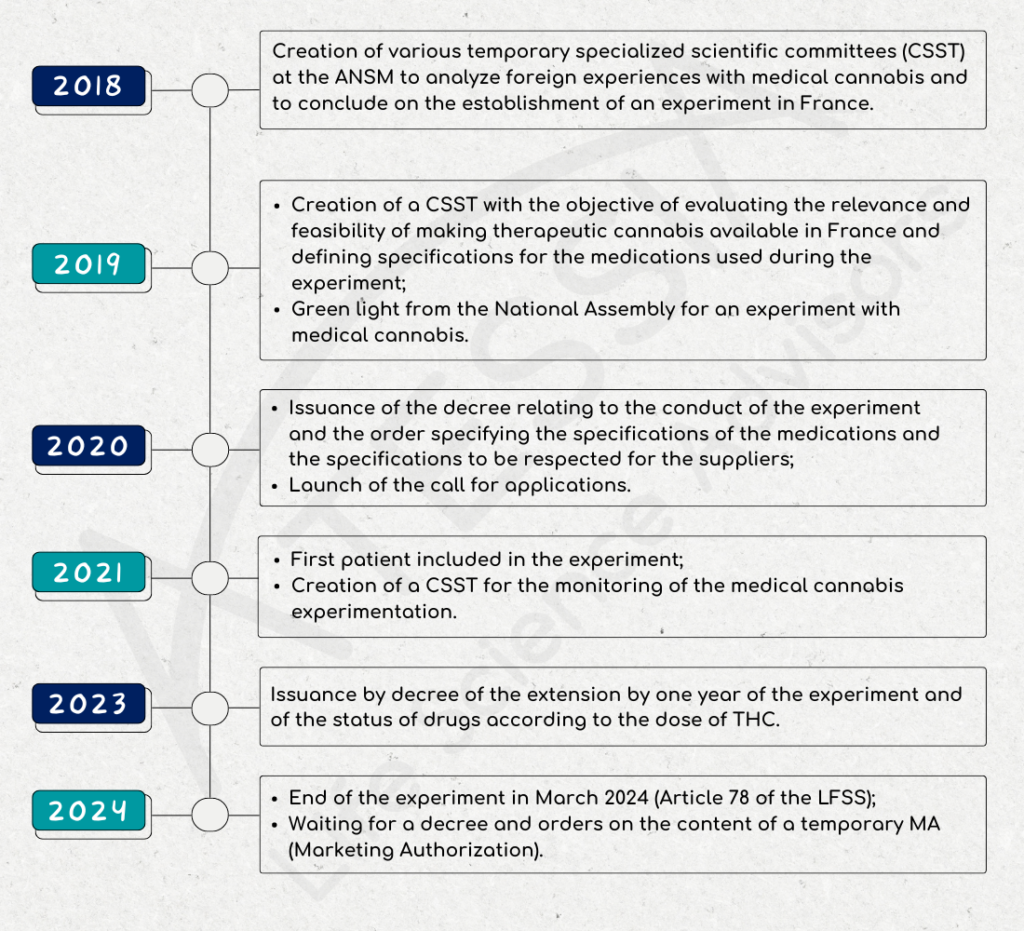
In September 2018, a multidisciplinary scientific committee made up of ANSM, healthcare professionals and patients was set up to review scientific knowledge and foreign experience on medical cannabis.   

In December 2018, this committee concludes that the use of cannabis is appropriate for patients in certain clinical situations, and wishes to set up an experiment.  

As of January 2019, a temporary specialised scientific committee (CSST) is being set up with the aim of assessing the relevance and feasibility of making therapeutic cannabis available in France. This CSST is tasked with issuing an opinion on:  

  • the therapeutic value of cannabis in the treatment of certain pathologies;  
  • the modalities for making cannabis available for medical use.  

At the same time, the committee had to define specifications for: 

  • The drugs used during the experiment;  
  • The content of training for doctors and pharmacists and information for patients;  
  • The content of the patient follow-up register.  

Launch of the experimental framework  

On October 25, 2019, the French National Assembly gives the go-ahead for an experiment in the use of medical cannabis.  

Decree no. 2020-1230 of October 7, 2020 on the experimentation of the medical use of cannabis defined in particular:   

  • the duration of the pilot (2 years),   
  • the status of medical cannabis as a narcotic drug,  
  • the number of patients who may be included,  
  • the conditions of treatment,  
  • the setting up of a register to monitor adverse events.  

The Order of October 16, 2020 set out the specifications for cannabis-based medicines used during the experiment provided for in Article 43 of Law no. 2019-1446 of December 24, 2019 on the financing of social security (LFSS) for 2020, together with the conditions for making them available and the therapeutic indications or clinical situations in which they will be used.  

This order defined:  

  • The indications for which medical cannabis products entered the trial,  
  • The authorized pharmaceutical forms:   
  • form for inhalation by vaporization, such as dried flowering tops or granules; 
  • oral form in capsule or equivalent form  
  • oral or sublingual oil form  
  • as well as specifications for the free supply and distribution of cannabis-based medicines for patients taking part in the experiment in the medical use of cannabis.  

The call for applications for therapeutic cannabis suppliers launched on October 19, 2020 by ANSM closed on November 24, 2020. Applications were examined on the basis of strict and demanding specifications in terms of compliance with good cultivation and manufacturing practices, drug quality and securing the distribution circuit as defined in the decree. This examination was carried out by the ANSM, and in particular by its control laboratories, and by experts from the Temporary Specialised Scientific Committee (CSST).  

In all, six supplier/operator pairs were selected for the trial.   

First patient – Start of the trial  

On March 26, 2021, the medical cannabis trial officially began with the inclusion of the first patient at Clermont-Ferrand University Hospital. The experiment will run for 2 years.   

In June 2021, a CSST was set up to monitor the medical cannabis experiment. It is made up of 16 members, including 4 patients and healthcare professionals, general practitioners, specialists in the therapeutic indications selected for medical cannabis, pharmacists and representatives of the Centre Régional de Pharmacovigilance (CRPV) and the Centres d’Evaluation et d’Information sur la Pharmacodépendance-addictovigilance (CEIP-A).  

This committee is involved in monitoring the progress of the experiment and must issue an opinion on the evaluation data collected and on the framework for the marketing and use of medical cannabis.  

2023: the first turning point  

Decree 2023-202 of March 25, 2023, amending Decree 2020-1230 of October 7, 2020:   

  • extends the trial period for the medical use of cannabis by one year;   
  • indicates that medicines with a THC content of over 0.30% are subject to the narcotics regime; conversely, those with a THC content of less than or equal to 0.30% are now subject to the regime for medicines covered by lists I and II of poisonous substances.  

At the same time, various decrees dated March 25, 2023 specify that:  

  • Pharmacovigilance and addictovigilance will now be handled in the same way as for other drugs;   
  • Inhalation granules have been discontinued;  
  • The ANSM is no longer responsible for selecting suppliers and operators of cannabis for medical use. The Direction Générale de la Santé (DGS) is now the competent authority in this area, via a public procurement contract. The medicines used will therefore no longer be supplied free of charge by participating companies.  

End of the experiment  

Article 78 of the Social Security Finance Act of December 26, 2023 puts an end to the experiment.  

As of March 26, 2024, no new patients can be included. Patients included before this date will still be able to benefit from their treatment, with the exception of inhaled forms.  

Other patients will have to wait until a medicine is authorized and available “no later than December 31, 2024” before they can benefit from a cannabis-based treatment for therapeutic use.  

Pending the completion of the work enabling the widespread use of therapeutic cannabis in France, the Ministry has decided to extend coverage for patients still undergoing treatment since the end of the trial on December 31, 2024. 

Therefore, until March 31, 2026, coverage for patients included in the experimentand still undergoing treatment will be provided under the same conditions and, exceptionally, for medications authorised as part of the experiment. 

Key figures of the experiment: 

Since the start of the experiment in March 2021, 3,209 patients have been enrolled, of whom 1,655 were still receiving treatment as of June 13, 2025

A growing number of healthcare professionals are involved in this experiment (figures as of June 2025): 

  • 341 registered volunteer referral centers
  • More than 700 physicians in referral centers, both in private practice and hospitals, 
  • More than 1,400 pharmacists

What’s next?   

Article 78 of the Social Security Finance Act for 2024 creates an ad hoc status for cannabis-based medicines and introduces, for those medicines, the authorisation of use for a 5-year temporary period granted by the French HAs.  

  • Therapeutic indications: 

A decree is expected to define the precise indications for these medications. 

Article 78 of the Social Security Finance Act for 2024 precises that such prescription may only be done if the use of these products meets the special needs of a given patient, and there is no suitable pharmaceutical packsize available, including due to the absence of effective marketing, with, for example, a marketing authorization (article L5121-1 4° of the CSP).  

  • Content of the application for temporary authorisation 

A decree is also pending to define the content of the application for temporary authorisation. A draft notice to applicants was published for consultation by the French HAs in July 2024 and guides future applicants on the expected content of these applications. 

It should be noted that the final texts are still awaiting official publication and that no applications for temporary authorization can be submitted at this time. 

Article written by Isabelle BARBIEUX, Senior Quality Assurance Consultant and Agathe DAUBISSE, Senior Regulatory Affairs Consultant 


Are you wondering? Want to get started?

Atessia is here to answer your questions and help you make your project a reality.

Call on our experts.