

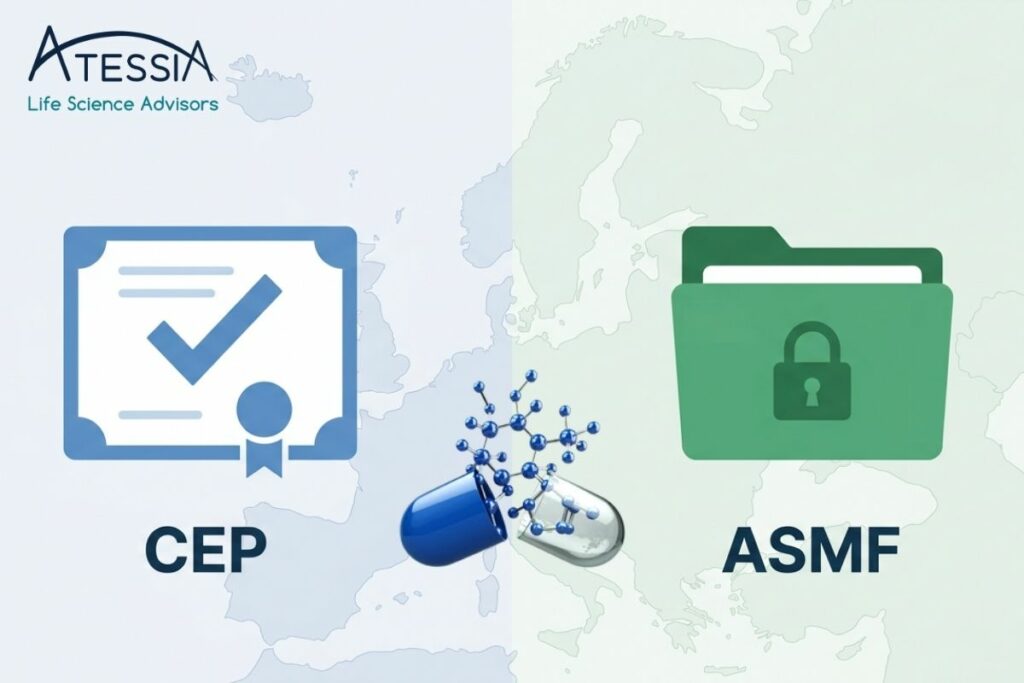
What are the different options for registering an active substance in a Marketing Authorisation (MA) dossier in Europe?
The description of the data relating to the active substance is part of the information that are mandatory in Module 3 of the Marketing Authorisation (MA) dossier. These elements must be presented according to the general structure described in Directive 2001/83/EC of the European Parliament and of the Council of 6 November 2001 establishing a Community code relating to medicinal products for human use.
However, although the substance of the required data is specified in the European regulation, the way in which these data are incorporated in the MA dossier may vary depending on the option selected by the applicant when approving its active substance manufacturer.
In Europe, the registration of a substance submitted by the MA holder may be carried out via an ASMF[1] (see Directive 2001/83/EC, Annex 1, Part 1, Chapter 3.2, Article (8)) or via a CEP (see Directive 2001/83/EC, Annex 1, Part 1, Chapter 3.2, Article (7)), with the choice of procedure being left to the active substance manufacturer (neither option being mandatory).
Another possibility is for the applicant to include, directly within the MA dossier, the data relating to the active substance in the form of a so‑called “full” scientific documentation package.
Different scenarios are distinguished depending on the type of active substance:
| Type of active substance: | Applicable documentation route: |
| New chemical entity (NtA, Volume 2A, Chapter 1, Annex I) | ASMF or full documentation |
| Substance included in the European Pharmacopoeia | ASMF or CEP or full documentation |
| Substance not included in the European Pharmacopoeia | ASMF or full documentation |
In this article, we focus on explaining the main differences between the CEP and the ASMF for registering an active substance in a marketing authorisation in Europe.
Focus on the CEP procedure
For further information on the CEP, see our blog article ‘What are CEPs?’.
Focus on the ASMF procedure
The requirements for the preparation of an ASMF in Europe are described in the EMA guideline entitled “Final Guideline on Active Substance Master File Procedure (CHMP/QWP/227/02, EMEA/CVMP/134/02)” and in the associated questions‑and‑answers document “Q&A on Active Substance Master File (ASMF)” jointly issued by the EMA and the CMDh.
The primary objective of the ASMF procedure is to ensure the protection of the intellectual property or confidential and valuable “know‑how” of the active substance manufacturer, while enabling the applicant or MA holder to assume full responsibility for the medicinal product, including the quality and quality control of the active substance.
The national competent authorities / the EMA have consequently access to all information necessary to assess the suitability of the active substance for use in the medicinal product.
Summary of the differences between the use of a CEP and an ASMF
A brief comparison of the advantages and disadvantages of the CEP and ASMF procedures for documenting the active substance section of a Marketing Authorisation Application (MAA) dossier is presented below.
| Criterion | CEP | ASMF |
| Confidentiality of the active substance manufacturer’s data | Very high The entire Module 3.2.S is confidential (shared only with EDQM, not with the MA holder) | High Module 3.2.S is divided into two parts: > Restricted Part confidential > Applicant’s Part non‑confidential |
| Assessment | Module 3.2.S assessed by EDQM (mutualised assessment). → Questions addressed only to the active substance manufacturer | Applicant’s and restricted parts assessed by the authority where the ASMF is submitted (non‑mutualised assessment – with the exception of ASMF worksharing procedure) → Questions on restricted part sent to the manufacturer; questions on applicant’s part sent to the MA holder |
| Workload for the MA holder | Low | Medium |
| Workload for the active substance manufacturer | High initially, then low | Medium |
| Management of MA variations related to the active substance | Very efficient: variations handled through CEP updates | Medium |
| When recommended? | Substance with a Ph. Eur. monograph / widely marketed active substance | Substance with or without a Ph. Eur. monograph / need to protect proprietary know‑how |
Regulatory procedures, evaluation times and associated costs vary.
ATESSIA consultants assist you in preparing your CEP and ASMF/DPSA files and submitting them to the authorities.
Article written by Isabelle MOUVAULT
Sources:
– EUR-Lex – Directive 2001/83/CE du Parlement européen et du Conseil du 6 novembre 2001 instituant un code communautaire relatif aux médicaments à usage humain
– EudraLex – Volume 2 – Notice to Applicants, Volume 2A, Chapter 1, Annex I
– EMA – Guideline on summary of requirements for active substances in the quality part of the dossier
– EMA – Final Guideline on Active Substance Master File Procedure
– CMDh – Q&A on Active Substance master file (ASMF)
[1] Active Substance Master File – previously known by the acronym EDMF (European Drug Master File).