

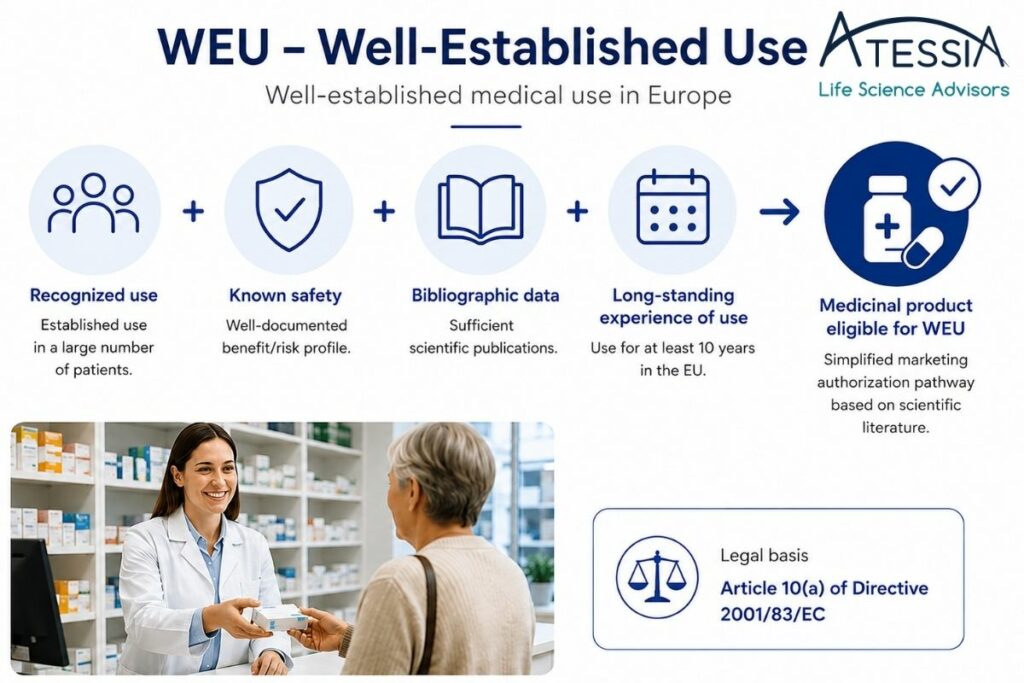
Definition
The legal basis of “well-established use/ WEU” (well-established use) in Article 10(a) of Directive 2001/83/EC constitutes a specific regulatory pathway for obtaining a marketing authorization (MA) for a medicinal product within the European Union (EU) without having to submit a complete dossier of original preclinical and clinical trials. This is referred to as a literature-based application. This approach relies on the use of existing scientific data demonstrating the efficacy and safety of an active substance with a long-standing and recognized use.
• Recognized medical use for at least 10 years in the EU,
• Efficacy and safety profile demonstrated to be acceptable based on usage,
•Scientific consensus widely documented in the literature.
These criteria imply that the assessment is based on a robust body of scientific evidence, including in particular:
• Publications in peer-reviewed journals,
• Meta-analyses,
•Clinical guidelines,
•Post-marketing experience data.
However, the existence of extensive literature alone is not sufficient to claim well-established medical use. The quality of the data, its relevance, and its suitability for the product under development remain key factors in the evaluation.
A scientific demonstration that goes beyond a simple literature review
One of the most common pitfalls is to view a WEU dossier primarily as a bibliographic exercise. In fact, the authorities generally expect more than just a compilation of publications. MA holders must be able to explain how the data described in the literature can be applied to their product. It is therefore not merely a matter of knowing whether data exist, but of determining to what extent this data supports the product in question and how this demonstration can be robustly documented.
Recent European clarifications have brought the topic of “bridging” back into the spotlight.
“Bridging” refers to a comparative analysis between the drug being submitted for approval and the product(s) cited in the scientific literature, in order to demonstrate that the data from the literature cited to support efficacy and safety are relevant to the specific drug being submitted for approval.
In 2025, the EMA published a Q&A document (“Clinical Pharmacology and Pharmacokinetics: Questions and Answers”) aimed at harmonizing the assessment of “bridging” requirements in applications based on Well-Established Use.
The guiding principle of this document is to demonstrate that the published data pertain to a product sufficiently comparable to the one for which the marketing authorization application is being filed. Depending on the situation, this demonstration may involve pharmaceutical, pharmacokinetic, or clinical analyses to establish the link between the data in the literature and the drug candidate for WEU.
The guidelines do not always provide a direct answer applicable to all scenarios. Rather, they emphasize the importance of a scientific justification tailored to each product and each registration strategy.
Areas in which Atessia can assist applicants:
•Analysis of the relevance of the legal basis under Article 10(a) in light of available bibliographic data;
•Identification of any bridging requirements;
•Structuring the regulatory strategy for the application: assisting you in a thorough review of the application’s overall consistency and the evidence supporting the choices made.
The goal is not to apply a one-size-fits-all approach, but to help applicants clarify the available options and ensure the overall logic of the development.
Sources :
Clinical pharmacology and pharmacokinetics: questions and answers
Article written by Véronique LEWIN, Senior Pharmaceutical Affairs Consultant – CMC