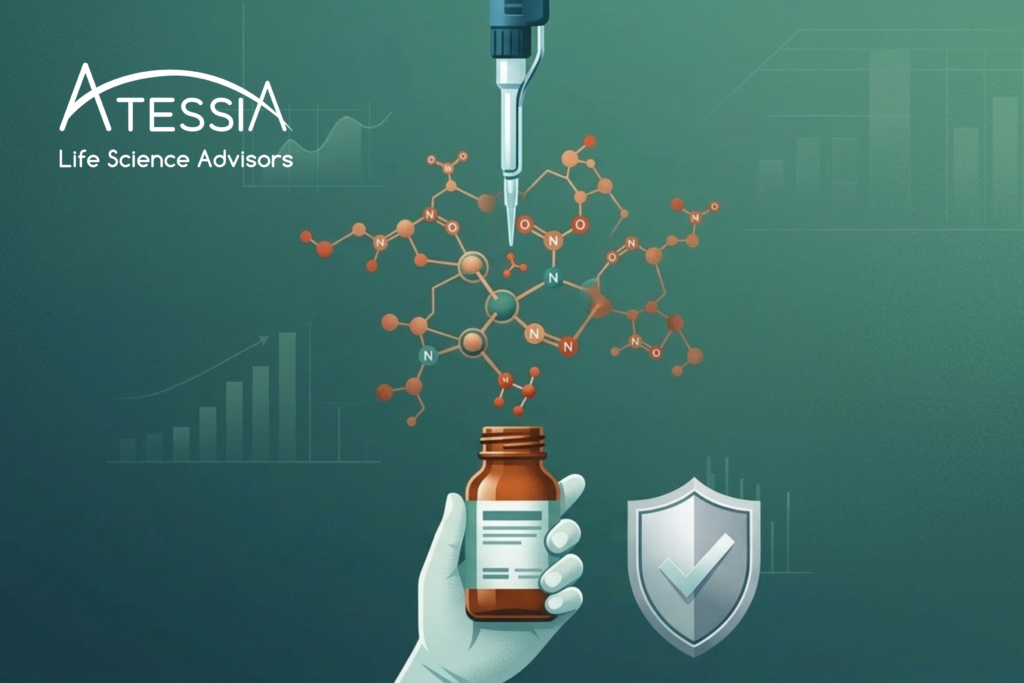
Since 2018, the risk of contamination of medicines by nitrosamine-type impurities has emerged as one of the most sensitive topics in pharmaceutical quality. What initially appeared as an isolated signal has become a true global regulatory issue, mobilizing authorities, manufacturers, and control laboratories. Understanding this risk—its origins and its implications—has now become essential for all stakeholders in the medicinal product lifecycle.
1. Where Does the Nitrosamine Risk Come From?
Nitrosamines are compounds classified as potentially carcinogenic. They can form under certain chemical conditions, particularly in the presence of:
- a nitrosatable agent: precursor (e.g., secondary, tertiary, quaternary amines and ammonium salts)
- a nitrosating agent (e.g., nitrites)
- a favorable environment (acidic pH, high temperature, aqueous phase, impurities)
There are two main types of nitrosamines:
- Generic nitrosamines: small, non‑specific molecules (e.g., NDBA, NDEA, NDIPA, NDMA, NEIPA, NMBA¹)
- Nitrosamine Drug-Related Impurities (NDSRIs): nitrosamines specific to active substances or their impurities, including:
- impurities resulting from nitrosation of an active substance (N‑nitroso impurity, i.e., NO‑API)
- impurities resulting from nitrosation of an impurity of an active substance
Due to their structure, approximately 40% of pharmaceutical active substances and 30% of their impurities are considered potential nitrosamine precursors².
Their detection in several “sartan” medicines (valsartan, candesartan, irbesartan, losartan, and olmesartan) highlighted a previously underestimated risk: the possibility of forming these impurities during synthesis, manufacturing, or even storage of the active substance or finished product.
2. A Strengthened Regulatory Framework
Given the scale of the issue, authorities such as the EMA, FDA, and Health Canada quickly issued expectations. In Europe, the EMA and CMDh published a series of guidelines and Q&A documents requiring Marketing Authorisation Holders (MAHs) to follow a structured three‑step approach (adopted by most EU national competent authorities):
Step 1 – Risk Assessment & Notification to Authorities
Each active substance and finished product must undergo a thorough analysis of potential nitrosamine sources as identified in the Q&A document (EMA/409815/2020).
Step 2 – Confirmatory Testing & Notification
If a risk is identified, validated analytical methods must be implemented to confirm or rule out the presence of nitrosamines.
Step 3 – Short-, Medium-, and Long-Term CAPA
If a nitrosamine is detected at levels exceeding 10% of the Acceptable Limit (AL)—derived from the Acceptable Intake (AI)—the manufacturer must propose corrective and preventive actions (CAPA), such as:
- modification of the manufacturing process
- change of raw material supplier
- change of primary packaging
- strengthened controls
- regulatory dossier updates
These requirements apply to chemical, biological, herbal, and radiopharmaceutical products.
The Q&A (EMA/409815/2020) describes when and how to submit Step 1 and Step 2 reports. Templates are available on the EMA, CMDh, and national authority websites.
Compliance is subject to regular authority oversight, including inspections.
3. Definition of Parameters and Toxicological Tests
The following toxicological parameters and tests are defined in ICH M7 “Assessment and control of DNA reactive (mutagenic) impurities in pharmaceuticals to limit potential carcinogenic risk” (Rev2):
AI – Acceptable Intake (ng/day)
- Maximum allowable daily amount (mass) for a given product, based on toxicity data (notably TD50).
- Associated with a negligible cancer risk.
- Based on the carcinogenic potency of a substance (TD50).
- Applicable to all routes of administration.
TD50 – Toxicological Dose 50 (mg/kg)
- Dose causing tumors in 50% of animals (equivalent to a cancer risk probability of 1:2).
AL – Acceptable Limit (ng/g or ppb)
- Maximum acceptable concentration of an impurity in a drug substance or product, derived from the AI and the Maximum Daily Dose (MDD).
4. European Reference Texts: A Constantly Evolving Regulatory Framework
Nitrosamine risk management now relies on a robust set of European documents, regularly updated to reflect scientific advances and regulatory experience. Key publications from the EMA and EDQM include:
- EMA “Questions & Answers on Nitrosamine Contamination”: the regulatory cornerstone detailing expectations for risk assessment, confirmatory testing, and risk reduction/minimization strategies
- CMDh guidelines: specifying MAH obligations, including deadlines for risk assessments and variations
- EDQM monographs:
- Specific monographs for the five initially affected active substances (valsartan, candesartan, irbesartan, losartan, olmesartan)
- Revised general monographs, with a dedicated “N‑Nitrosamine” paragraph added under “Production”:
- General monograph 2034 “Substances for Pharmaceutical Use”
- General monograph 2619 “Pharmaceutical Preparations”
Six analytical procedures for quantifying NDSRIs and impurities from manufacturing intermediates, developed by OMCLs, are available on the EDQM website (Nitrosamine testing activities of the OMCL Network).
These documents form an essential reference framework for industry, which must not only comply but also maintain active regulatory surveillance. Current trends clearly show that European authorities will continue refining their expectations, reinforcing the need for a proactive and well‑documented approach.
5. Long-Term Vigilance
- European regulatory authorities (EMA/CMDh/EDQM) have continuously adjusted their recommendations to control risks, based on real‑time scientific knowledge. This has significantly disrupted the entire pharmaceutical supply chain (API manufacturers, finished product manufacturers/MAHs).
- Reference regulatory texts evolve rapidly; MAHs must monitor updates in real time. Tools such as questionnaires are provided to support MAHs in conducting the required risk assessments.
Manufacturers must therefore maintain continuous surveillance, integrate this risk into their quality systems, and follow regulatory developments closely.
Conclusion
The nitrosamine issue has profoundly transformed how the pharmaceutical industry approaches impurity control. Beyond regulatory compliance, it is a matter of patient trust and safety. Companies adopting a proactive, scientific, and well‑documented strategy will be best positioned to meet regulatory expectations and ensure product quality.
Atessia supports manufacturers in their compliance strategies.
1. NDBA: N‑nitrosodibutylamine; NDEA: N‑nitrosodiethylamine; NDIPA: N‑nitroso‑diisopropylamine; NDMA: N‑nitrosodimethylamine; NEIPA: N‑nitroso‑ethyl‑isopropylamine; NMBA: N‑nitroso‑N‑methyl‑4‑aminobutyric acid.
2. Schlingemann et al. J. Pharm Sci. 112 (2023), 1287 1304
Sources :
CMDh/412/2019: CMDh practical guidance for Marketing Authorisation Holders of nationally authorised products (incl. MRP/DCP) in relation to the Art. 5(3) Referral on Nitrosamines
EMA/409815/2020: « Questions and answers for marketing authorisation holders/applicants on the CHMP Opinion for the Article 5(3) of Regulation (EC) No 726/2004 referral on nitrosamine impurities in human medicinal products.
EMA/144509/2025 : Nitrosamine impurities in human medicines
ICH M7(R2) Guideline on assessment and control of DNA reactive (mutagenic) impurities in pharmaceuticals to limit potential carcinogenic risk
Article written by Alison HEWAT